Opening sequences from Trefossa: Mi a No Mi (2008), directed by Ida Does
Mi a no mi
solanga mi brudu
fu yu a n'e trubu
na ini den dusun titei fu mi
I am not myself
until my blood
is infused with you
in all of my veins
— From "Gronmama" ("Earthmother"); English translation by Quinton Zondervan
If Suriname has a national poet, Henri Frans de Ziel (1916-1975), who wrote under the pseudonym Trefossa, is perhaps the leading candidate. His groundbreaking 1957 book Trotji, the first published collection of Sranan poems, has been called "the big bang of Surinamese literature." Thousands of Surinamese schoolchildren sing his verse daily — he wrote the Sranan part of the national anthem.
Trefossa: Mi a No Mi (2008), a documentary by filmmakers Ida Does and Paul van den Bos, uses interviews, historic film footage, and Trefossa's own words — from his published poems and unpublished diaries — to tell his story, chart his influence on two generations of Surinamese writers, and investigate how the power of his poems helped legitimise Sranan Tongo in both Suriname and the Netherlands.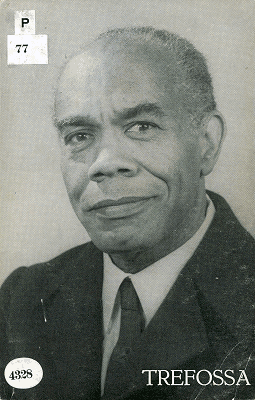
Portrait of Trefossa courtesy the DBNL
The text of Ala Poewema foe Trefossa ("Collected Poems of Trefossa", 1977) is available online at the Digitale Bibliotheek voor de Nederlandse Letteren.
Seen: Trefossa, by Ida Does
Saturday, September 5, 2009
Project: Arnold Schalks, Someni Tongo
Friday, August 14, 2009

Participants in Someni Tongo at the STVS studio, 22 November, 2008
Rotterdam-based Dutch artist Arnold Schalks is one of the participants in the ArtRoPa project, and the instigator of the journal De Surinoemer. In late 2008, during his artist's residency in Paramaribo, he created Someni Tongo, a community project that centres around poetry and recitation.
"Someni tongo" is a line from the poem "Wan Bon" ("One Tree") by the celebrated Surinamese poet and performer R. Dobru. Schalks interpreted "someni tongo"--"so many tongues"--as an imperative, and had Dobru's poem translated from Sranan into fifteen other languages spoken in Suriname: Arawak, Aukan, Chinese, English, Hindi, Modern Hebrew, Javanese, Kaliña, Lebanese, Dutch, Portugese, Saramaccan, Sarnami, Spanish, and Trio.
Premiere of Someni Tongo, broadcast on STVS
Schalks incorporated the sixteen translations in a five-part arrangement for a speaking choir. The translations are interwoven in such a way that each part sheds a different light on the poem's theme, "unity in diversity"/"diversity in unity". In each part, the sixteen voice-groups (one for each language) pronounce their versions of the poem simultaneously. The mixed choir, composed of 43 Surinamese, was conducted by Eldridge Zaandam and accompanied by the percussionist Ernie Wolf.
Someni Tongo was performed twice in Paramaribo: on Saturday, 22 November, 2008, at in the STVS studio, and on Saturday, 29 November 2008, in the Palmentuin. Schalks also produced a limited-edition DVD documenting the project in still and moving images.
"What I like about Dobru's poem is that it initially appears to be simple, something that must have been made with great ease. But if you look closer, you see a tremendously ingenious, sophisticated poem. I parsed it with respect, and tried to find just the proper visualisation of it. 'Someni tongo' was my starting point. Once you have so many languages, you also need people who speak those languages. And if these people finally line up, then 'someni prakseri', 'someni wiwiri', 'someni skin' but also 'wan pipel' suddenly become visible. You're looking at a sculpture. The perfect visualisation of the poem."
--Arnold Schalks, interviewed in November 2008 on the Skrifiman Taki ("Writer's Talk") radio programme, SRS-radio.
Someni Tongo performed at the Palmentuin, 29 November, 2008
For more information about Someni Tongo, including the names of the participants in the performance, see Arnold Schalks's website.