By Nicholas Laughlin
Battle of Hispagnola posters along Kleine Waterstraat, Paramaribo, 28 June, 2009; photo by Nicholas Laughlin
An urban landscape is defined not only by buildings and squares and streets, but also by the people who inhabit and pass through them, their vehicles and equipment and merchandise, and the ephemeral traces they leave behind in the form of signs, graffiti, and posters.
Walking around Paramaribo, I noticed there were specific locations — the walls of abandoned buildings, temporary fences and hoardings — where event promoters advertise their parties, concerts, or sports tournaments, sticking up posters in overlapping dozens or even scores to achieve maximum visibility. In late June 2009, three events dominated this urban wallpaper: a "Battle of Hispagnola" boxing tournament, pitting Surinamese fighters against a team from the Dominican Republic; a concert by the visiting Congolese performer Djouna "Big One" Mumbafu; and the Lustig Festival, a big party organised by private promoters at a river beach inland from Paramaribo.
Djouna Big One and Lustig Festival posters along the Waterkant, Paramaribo, 24 June, 2009; photo by Nicholas Laughlin
Of the three, the Lustig Festival posters were the most arrestingly surreal. They emphasised the white sand of the beach location, and the event's tagline — "A Caribbean Fusion of Fantasies" — achieved visual form in a montage of stock photos. A flamingo, an alligator, three pots of gold, a monkey, colourful tree frogs, a bottle of Champagne, a toucan, and a young woman with Latin features — wearing a tiny bikini — burst forth from a pirate's treasure chest. You could write a whole dissertation on what this assemblage of images in this context says about Suriname's relationship to the Caribbean, or to ideas of "Caribbeanness".
Behind the Mask (mixed media, 120 x 145 cm, 2008) by Ravi Rajcoomar; image courtesy the artist
Ravi Rajcoomar's recent paintings, with their bold colours, graphic deployment of text, stencilled silhouettes, and palimpsestic collages, make explicit reference to street posters, graffiti, and the accidental, evolving "murals" created by layers of paint, paper, and glue on Paramaribo's urban surfaces. Their mirror-reversed text fragments and ambiguously gesturing human figures suggest stymied communication: a dream diary, a narrative without a key, a map missing its legend. He writes that these works explore "the mystery, the unknown, the untold, the unspoken, and the unsaid" of human interaction.
More immediately and subtly than a traditional topographical view — a rendering of a picturesque building or bustling market scene — Rajcoomar's paintings record the city of Paramaribo, close up and at street level. Words depicted as graphic forms overlap like voices from a crowd. Chaos plays against order, energy against melancholy, as in urban landscapes anywhere in the world, but letterforms hinting at Afaka script ground these works in Suriname, in Paramaribo.
Rajcoomar at work in his studio during his recent residency in Rotterdam; image courtesy the artist
See more of Rajcoomar's recent works at his website.
Conjunction: street posters/Ravi Rajcoomar
Monday, October 26, 2009
Seen: Trefossa, by Ida Does
Saturday, September 5, 2009
Opening sequences from Trefossa: Mi a No Mi (2008), directed by Ida Does
Mi a no mi
solanga mi brudu
fu yu a n'e trubu
na ini den dusun titei fu mi
I am not myself
until my blood
is infused with you
in all of my veins
— From "Gronmama" ("Earthmother"); English translation by Quinton Zondervan
If Suriname has a national poet, Henri Frans de Ziel (1916-1975), who wrote under the pseudonym Trefossa, is perhaps the leading candidate. His groundbreaking 1957 book Trotji, the first published collection of Sranan poems, has been called "the big bang of Surinamese literature." Thousands of Surinamese schoolchildren sing his verse daily — he wrote the Sranan part of the national anthem.
Trefossa: Mi a No Mi (2008), a documentary by filmmakers Ida Does and Paul van den Bos, uses interviews, historic film footage, and Trefossa's own words — from his published poems and unpublished diaries — to tell his story, chart his influence on two generations of Surinamese writers, and investigate how the power of his poems helped legitimise Sranan Tongo in both Suriname and the Netherlands.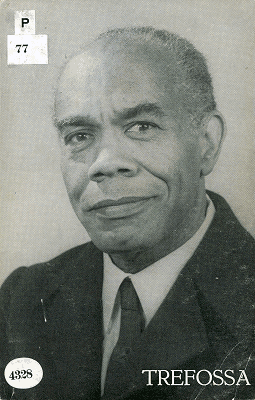
Portrait of Trefossa courtesy the DBNL
The text of Ala Poewema foe Trefossa ("Collected Poems of Trefossa", 1977) is available online at the Digitale Bibliotheek voor de Nederlandse Letteren.
Response: some thoughts on Someni Tongo
Wednesday, September 2, 2009

Part of the audience at the performance of Someni Tongo in the Palmentuin, 29 November, 2008
Just over two weeks ago, Paramaribo SPAN posted information on Dutch artist Arnold Schalks's Someni Tongo project (2008), which examined Suriname's cultural and linguistic diversity through a live performance of a celebrated poem. The comments left on the original post raised interesting questions about how this and other art projects are (or could or should be) received and interpreted by audiences and the wider art community.
Writer Chandra van Binnendijk, who witnessed the live performance of Someni Tongo, offers her personal response to the project and the resulting discussion.
I was one of the handful of people on that early Sunday morning in the Palmentuin nine months ago, there to watch the performance of Someni Tongo. There was a kind of silent conspiracy-like feeling, for being together for the event. The ones with cameras wanted to take pictures, but the best angle near the podium was not approachable: a vagrant had left a fresh turd right in that spot. And the manager of the Palmentuin refused to clean it up, for this was not his duty, he said.
It did not bother us at all: we placed an old newspaper on top of it, we warned others not to step on it, we moved around a little until everyone found his best place around the podium, and then we watched and experienced and enjoyed the Someni Tongo performance. All those tongues, speaking in all those different languages, expressing the same lines -- it was special, it was beautiful, and more so because we were there for the live experience.
The audience that morning left the Palmentuin with a feeling of upliftment, of contentment.
Shouldn't a similar feeling of contentment remain with the one who created this beautiful experience? What happens to the artist when he is so attached to the fruit of his work that he feels disappointed when response and feedback from the public are not what he expects (or even feels he deserved)? When he is not praised or imitated? Where is the pure joy of creating?
I think art is exactly and only about this: the need to create and express what is uniquely inside you, and to do so because you have no choice. Something is envisioned, it wants to come into the world through you, and it can only be born through your effort. Full stop. No ulterior motives. Creation is making art -- not the aftermath.
Someni Tongo was beautiful. But in its significance it was not unprecedented. Over the years, Suriname has seen high-level performances of multi-racial, muli-ethnic, and multi-lingual performances. One example is the theatrical production Rebirth, by director Henk Tjon, which was presented at Carifesta 1981 in Barbados, with a dazzling combination and integration of all these aspects. There have been performances by the National Ballet of Suriname choreographed by Ilse-Marie Hajary, who created the Dogla style, in which she integrated Afro drumming and winti elements with classical Indian dance movements.
So multi-culti is not really new for us. One should not overlook history -- we are able to reach heights because we are standing on the shoulders of those before us. Tjon and Hajary were not greeted with lavish standing ovations -- their work was not understood at first. This takes time.
On that beautiful mormning in the Palmentuin, we did not let the turd disturb us. Because the performance was compelling. The experience was enough.
Art in itself is enough.
Project: Arnold Schalks, Someni Tongo
Friday, August 14, 2009

Participants in Someni Tongo at the STVS studio, 22 November, 2008
Rotterdam-based Dutch artist Arnold Schalks is one of the participants in the ArtRoPa project, and the instigator of the journal De Surinoemer. In late 2008, during his artist's residency in Paramaribo, he created Someni Tongo, a community project that centres around poetry and recitation.
"Someni tongo" is a line from the poem "Wan Bon" ("One Tree") by the celebrated Surinamese poet and performer R. Dobru. Schalks interpreted "someni tongo"--"so many tongues"--as an imperative, and had Dobru's poem translated from Sranan into fifteen other languages spoken in Suriname: Arawak, Aukan, Chinese, English, Hindi, Modern Hebrew, Javanese, Kaliña, Lebanese, Dutch, Portugese, Saramaccan, Sarnami, Spanish, and Trio.
Premiere of Someni Tongo, broadcast on STVS
Schalks incorporated the sixteen translations in a five-part arrangement for a speaking choir. The translations are interwoven in such a way that each part sheds a different light on the poem's theme, "unity in diversity"/"diversity in unity". In each part, the sixteen voice-groups (one for each language) pronounce their versions of the poem simultaneously. The mixed choir, composed of 43 Surinamese, was conducted by Eldridge Zaandam and accompanied by the percussionist Ernie Wolf.
Someni Tongo was performed twice in Paramaribo: on Saturday, 22 November, 2008, at in the STVS studio, and on Saturday, 29 November 2008, in the Palmentuin. Schalks also produced a limited-edition DVD documenting the project in still and moving images.
"What I like about Dobru's poem is that it initially appears to be simple, something that must have been made with great ease. But if you look closer, you see a tremendously ingenious, sophisticated poem. I parsed it with respect, and tried to find just the proper visualisation of it. 'Someni tongo' was my starting point. Once you have so many languages, you also need people who speak those languages. And if these people finally line up, then 'someni prakseri', 'someni wiwiri', 'someni skin' but also 'wan pipel' suddenly become visible. You're looking at a sculpture. The perfect visualisation of the poem."
--Arnold Schalks, interviewed in November 2008 on the Skrifiman Taki ("Writer's Talk") radio programme, SRS-radio.
Someni Tongo performed at the Palmentuin, 29 November, 2008
For more information about Someni Tongo, including the names of the participants in the performance, see Arnold Schalks's website.
Conversation: bridges and silences
Tuesday, July 14, 2009
=
Brug
Auto's daveren
over de brug
maar de kreek
voert uit het bos
nieuwe stilten aan
-- Eddy Pinas
Bridge
Vehicles thunder
over the bridge
but the creek
brings new silences
from the forest
-- trans. Marieke Visser
Marieke Visser: The idea is clear: the fact that a bridge can bring worlds together is not necessarily a blessing. It should not be taken lightly.
The bridge over the Suriname River is to me also a strong reminder of the May demonstrations in 1999, when many of us went out on the streets to protest the presidency of Jules Wijdenbosch. He was the one who built this visible bridge, this symbol of hope, of growth, of expansion. We shouted: "We don't want bread with bridge!" But after a few days everything went back to normal. And now, now and then, I notice thoughts in my own head like: "Well, at least he built something tangible for the country!"
Chandra van Binnendijk: I am intrigued by this little poem. Not only because of its simple beauty, but because the poet refers to "silences", indicating there is more than just one silence. The creek supplies us with new silences, he says--and I wonder: Are these more of the same, or do we get a variety, will we get different kinds of silences each time the creek brings them to us?
When playing around with these questions, my image of the bridge changed, it widened the scope of how we could look at a bridge. It is not just a construction which links one bank of a river to the other, but it also has something above it--air--and something underneath it--water or ground. The water brings new silences, but the water itself has many layers--there are the bubbles and the waves on the surface, but there are also the undercurrents. The same goes for the air above the bridge. So looking at a bridge in a wider sense we could see it as one (horizontal) layer of many in its wider surroundings. What does one see when looking at the surroundings while standing on the bridge?
MV: I think of a friend, the visual artist René Tosari, the man behind Waka Tjopu. More than anyone I know, he is at home in both worlds: the artists in the diaspora and the artists at "home", but also the worlds of the older generation and the younger generation. I don't see him as a bridge builder or a bridge--it is more like that he is a person on the bridge, accepted by both worlds as someone who "belongs" to their world.
When I think about this image, a man standing on the bridge, walking to both sides, sharing with people on both sides, I see how this is how I myself feel. That is also why the Wakaman Project was so exciting. It transcends that issue of home or away, of that recurring--and sometimes very irritating and time-consuming--question of which world we belong to. I don't want to choose, I am not willing to defend one world over another. But I do speak both languages, and I do miscommunicate in both languages as well. On both ends of the bridge are sources of inspiration, which I feel free to be inspired by.
I have the feeling that more people are moving in that direction, and I see how the bridge can be a way to get out of a place that has become too limited, and maybe later on it is a means to return with new stuff in your suitcase. But also the bridge itself means a new freedom--it is like an opened window (to the future but also to the past). It is an opportunity to connect and to re-connect and to cut loose (disconnect) as well.
Untitled (1998), by René Tosari; photo by Roy Tjin