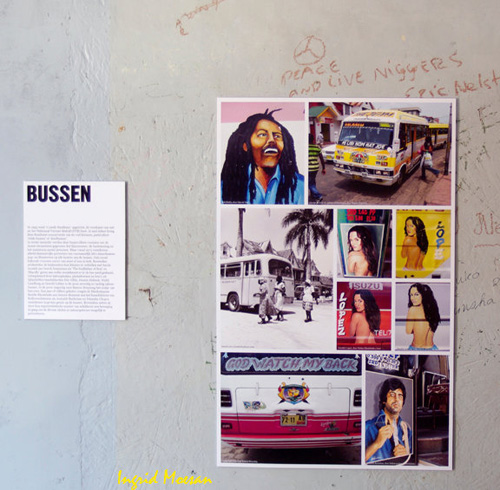
Images of bus paintings installed in the Schaafijs en Wilde Bussen exhibition; photo by Ingrid Moesan
Paul Faber, co-author of Schaafijs en Wilde Bussen: Straatkunst in Suriname, reports on an “Art Conversation” which brought together some Paramaribo SPAN artists and various street artists best known for their paintings on buses, walls, and shopfronts
Sunday evening, 7 March, 7 pm. Location: the garden of DSB Bank in Paramaribo. Inside and outside the central pavilion the works of the SPAN artists have found their own environment. Tonight the exhibition receives some special guests, a group of painters who make their living by painting buses and walls.
These painters rarely visit art exhibitions. They are here by invitation, because they created works that will be presented in an exhibition of their own, Schaafijs en Wilde Bussen, at Fort Nieuw Amsterdam. Sirano Zalman gives a guided tour for the street artists and other visitors. He shows the works, gives explanations, introduces other participating artists, such as George Struikelblok.
At 7.30 the crowd gathers in the back garden near Roberto Tjon A Meeuw's Fatu Bangi, a nice piece of wooden art-furniture, in front of a big clump of bamboo. About seventy people are present: the artists from both exhibitions, other interested artists, and art lovers. Magnificent palm tress and flowering bushes illuminated by hundreds of lights form a wonderful setting.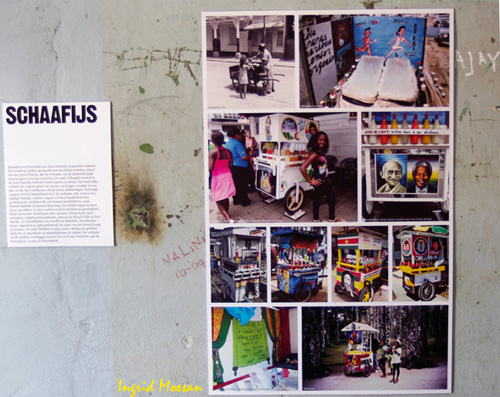
Images of painted shaved-ice carts in the Schaafijs en Wilde Bussen exhibition; photo by Ingrid Moesan
Karin Lachmising leads the conversation that unfolds over the next hour. Can you have a meaningful conversation between seventy people? Amazingly, the answer is an outright yes. The underlying question of this conversation is to discover how these two groups relate to each other. They obviously move in different circles, hardly know each other, and their jobs are structured in different ways. On the other hand, they are all “visual workers”, as someone puts it, and are dedicated to their work: how do they see each other’s work and (how) can they learn from each other?
The conversation, moving from one artist to another, touches in a natural and respectful way on all relevant issues. One of these is the message of the work. Some of the SPAN artworks deal with complex issues like pollution of the environment, suicide, and orphans. The commentary given during the tour helps a lot to explain the thoughts behind them, Ghalied Khodabaks says. The SPAN artists were obviously involved in what they wanted to say. But, as several discussants state, the street artists have their message too, more specified and narrow, but very clear at the same time. The bus painters concentrate on stars and heroes, emblems of beauty, to attract people. The painters of advertisements depict all kinds of products, like tomatoes or beer, in a way that makes the onlooker very thirsty indeed. It is the art of seduction, someone suggests.
The origin of this difference in the character of the message can be found in the relation with the commission. As André Sontosoemarto explains, the street artists have to deal with the clients, often companies, who order the paintings, and have specific requirements. The freedom of choice is limited for the painters, but not nil. The margin shows in the continuous innovation and development of ideas, techniques, and motifs.
It depends also on the artist's reputation. The bus painters like Ramon Bruyning and the Khodabaks brothers are known for the quality of their work and often get a free hand in the choice of motifs. Sirano admires their skills: how did you learn to paint so well, he asks. André explains there is hardly proper schooling in advertisement painting. Ideas to do something about this are presented on the spot. The bus painters are largely self-taught. They learned their art by using their eyes and practising with their hands, over and over again. Their standard is exceptionally high, also by international standards. Another interesting difference comes to light: the stage and the audience. “The whole city is our exhibition hall!” the street painters state proudly.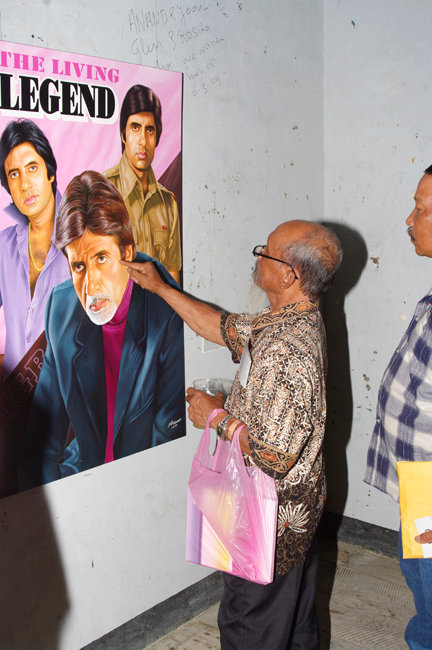
Soeki Irodikromo looks at one of the specially commissioned paintings; photo by Ingrid Moesan
At this point, the input of several painters of the older generation is enlightening. René Tosari, Winston van der Bok, John Djojo, and Steve Ammersingh were part of the artists’ collective Waka Tjopu, founded in the early 1980s. They relate the discussion of tonight to the objectives and ideals of then. Waka Tjopu brought art into the street, went for direct communication, painted large billboards, and avoided the use of the word “art”.
These stories link tonight’s conversation with a broader and deeper tradition in the Surinamese world of “visual workers”. A passionate speech by grand old man Soeki Irodikromo, whose daughter Sri participates in Paramaribo SPAN, rounds up this highly interesting evening. He implores people to continue this exchange, suggested that the painters leave some permanent mark in Fort Nieuw Amsterdam.
Tonight the street artists were confronted with a number of new ideas and possibilities, but also with respect and appreciation from new-found colleagues. Next Friday a nicely painted bus will leave from the Paramaribo SPAN exhibition venue for Fort Nieuw Amsterdam and the opening of Schaafijs en Wilde Bussen. After a quick family meeting, the Khodabaks brothers announce that they will provide the bus, which is bound to be a high-class example of their Bollywood style. It is a nice thought to be able to travel inside an artwork to an opening.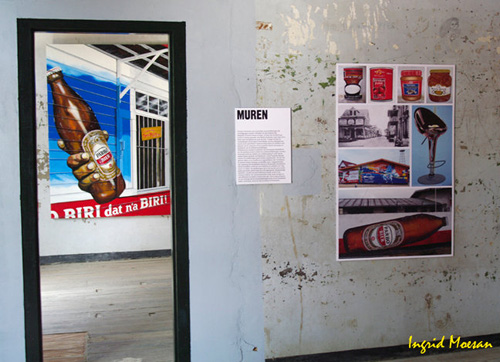
Images of wall paintings in the Schaafijs en Wilde Bussen exhibition; photo by Ingrid Moesan
Schaafijs en Wilde Bussen, an exhibition of Surinamese street art (including specially commissioned works) runs from 13 March to 2 May in the Open Air Museum of Fort Nieuw Amsterdam in the Commewijne district.
Diary: SPAN meets street
Monday, March 15, 2010
Notes: on bridges and meetings
Wednesday, August 26, 2009
By Christopher Cozier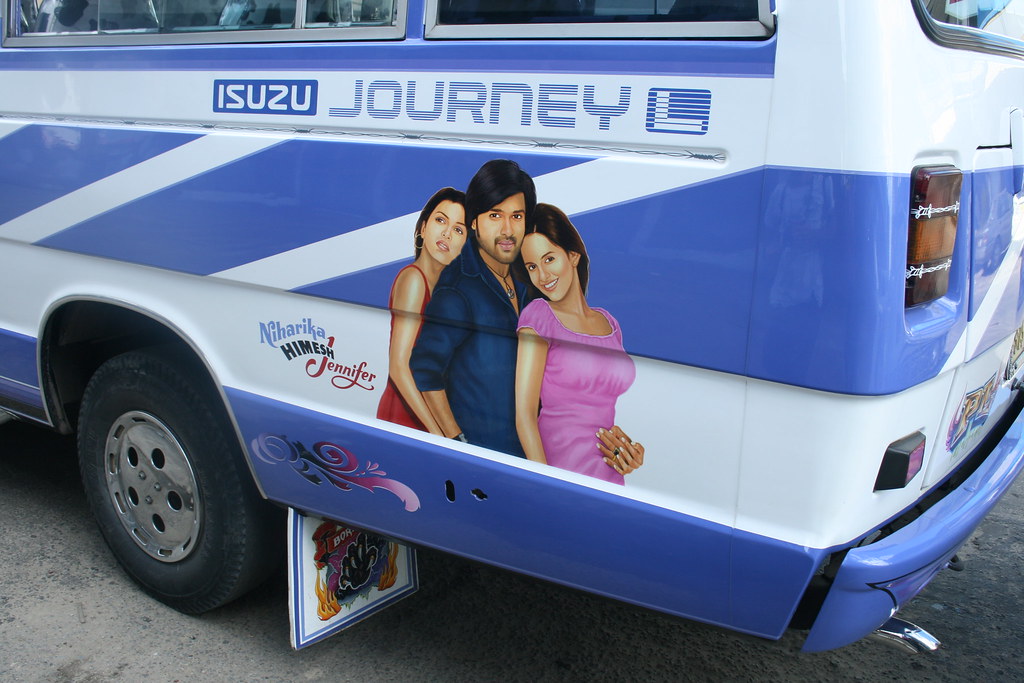
Painting of Bollywood stars on a minibus in downtown Paramaribo, June 2009. Photo by Christopher Cozier
Initially, I was thinking of a theme around bridges, derived from the obvious: the two distinctive bridges, the Jules Wijdenbosch Bridge in Paramaribo and the Erasmus Bridge in Rotterdam. Both registered on my mind from the landscape on my first visits. For both cities, the bridges are significant to their stories and ambitions, reaching across not just water but communities and ways of understanding or experiencing where they are located. To me, this spoke about the role of visual practice and its dialogues--its potential to make connections between artists working in different but related circumstances.
In discussion with Marcel Pinas, Chandra van Binnendijk, Marieke Visser, Thomas Meijer, and Nicholas Laughlin, in what’s left of the iconic bar at the Torarica Hotel, the word “span” came up. Nicholas wanted to know whether, in local languages or Dutch, the word carried any further meanings or usages. I was still processing “ontmoeting”, the title of one of Soeki Irodikromo’s new paintings. It was a gestural work, with his distinctive and adventurous use of colour, which for him expressed a meeting point--an unlikely reckoning of people and ideas, but distinctive of the region. Like “span”, it conveyed the purpose or the idea.
Span is a word common to English, Dutch, and Sranan, via different etymologies, and with a range of meanings, nuances, implications. It is the space between two points, the means of crossing that space, a linking or pairing, a tension, a tightening, an excitement, a fullness, a reaching out.
What we in the Caribbean call Suriname is really Paramaribo, like Georgetown in Guyana: a coastal settlement with what appears to be an unfathomed “interior” and an ocean in front of it--or is it the other way around, with the ocean at its back? These settlements sit between two apparently infinite domains. It is a place between the Amazon and the Caribbean Sea ... a kind of entry point to something--something out-there or in-there that is not fully grasped.
On my first visit to Suriname, as I drove across the Jules Wijdenbosch Bridge, I felt that I was reaching inward and outward simultaneously. Ideas of the Caribbean, heavily shaped by island-ness, begin to diminish. This is the northern edge of a very large continent, and one of the starting points of exploration, conquest, and the ongoing formulation of the otherness of its climate, people, and landscape.
Why and how I see Suriname as a Caribbean place remains an open question. Is it because of the post-colonial, post-plantation dynamics of the transplanted people and architecture, or is it because the passing cars are thumping--reacting and agitating with Bollywood and dancehall beats?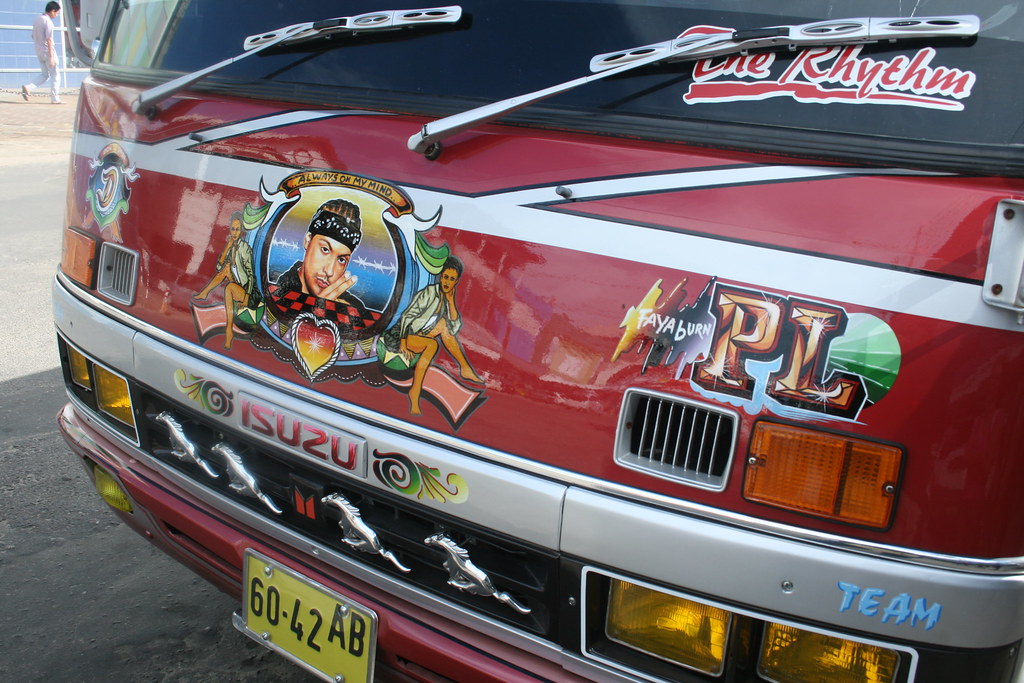
Painting of dancehall star Sean Paul on a minibus in downtown Paramaribo, June 2009. Photo by Christopher Cozier
Like many who engage the Caribbean, for me the question Where is the Caribbean? often comes up. Because of emigration and expanding diasporic communities spread across Europe and the Americas, the Caribbean is best understood as a space rather than a specific location or place. Its permeable boundary may not delineate a particular territory.
This space is constantly shifting and expanding. The Caribbean is wherever its people find themselves and wherever people imagine the Caribbean. We are all now operating within this critical space. This is a challenging moment, as we all, not just in Europe, find ourselves in danger of slipping backwards into the despair of ethnic, cultural, and national territories or enclosures, not always for self-awareness but for vicious local squabbles over diminished resources.
The Caribbean in which Paramaribo resides or to which it reaches out or is sometimes narrated can also be seen as a critical space defined by certain questions about labour camps evolving into societies, about transplanted populations and early moments of Modernity defined by transnational labour sites and trade routes, and relations between competing European kingdoms transforming into nation states. By the struggle for its subjects from being property to being citizens--from being owned to owning. The Caribbean's relationship to Brazil or to Cayenne are all being processed.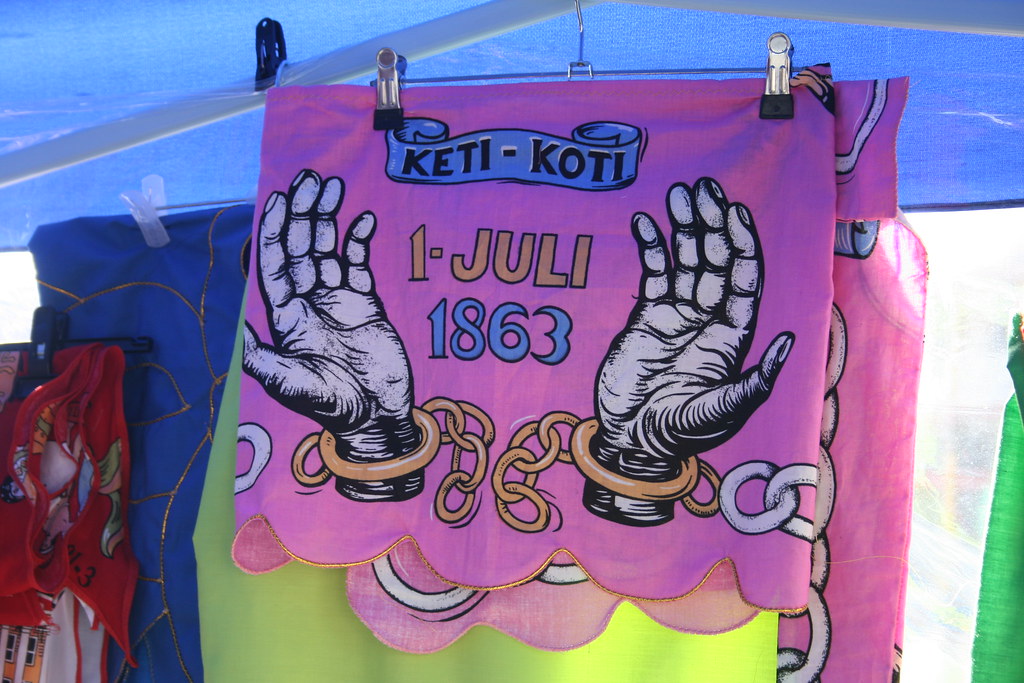
Keti Koti cloth commemorating Emancipation, in a street vendor's tent in downtown Paramaribo, June 2009. Photo by Christopher Cozier
I do not think it is useful to the artists here for the Paramaribo SPAN project to be just a themeless national/cultural or ethnic list or inventory, with passport portraits, biographies, and a single work represented by a static image--a mere generic national culture calling card. There are too many books like that, and they do little to allow critical entry to the work and ideas of the artists.
The Rotterdam participants in the ArtRoPa project may be seen as belonging to a national discourse and an implied larger European and assumed “Internationalist” pedestal of old. Within this narrative, the Surinamese artists sit apart and within a fixed national, assumed cultural boundary and distanced placement--even those currently living and working in Europe. They are trapped within an overly defined representative role--a designation. Neither can see each other. We cannot really see them.
However, in response to today’s global questions, all of these assumptions mutually impose the same restricted readings. How can Paramaribo SPAN bring all of these participating artists into a critical context that does not make restrictive displays of their “difference” for consumption? How can we create a platform that unravels their common concerns as visual practitioners? To me, this can only be accomplished by looking at the work itself and by listening to the artists to see how these concerns may give shape to curatorial purpose--allowing a meeting point between curatorial and artistic intent.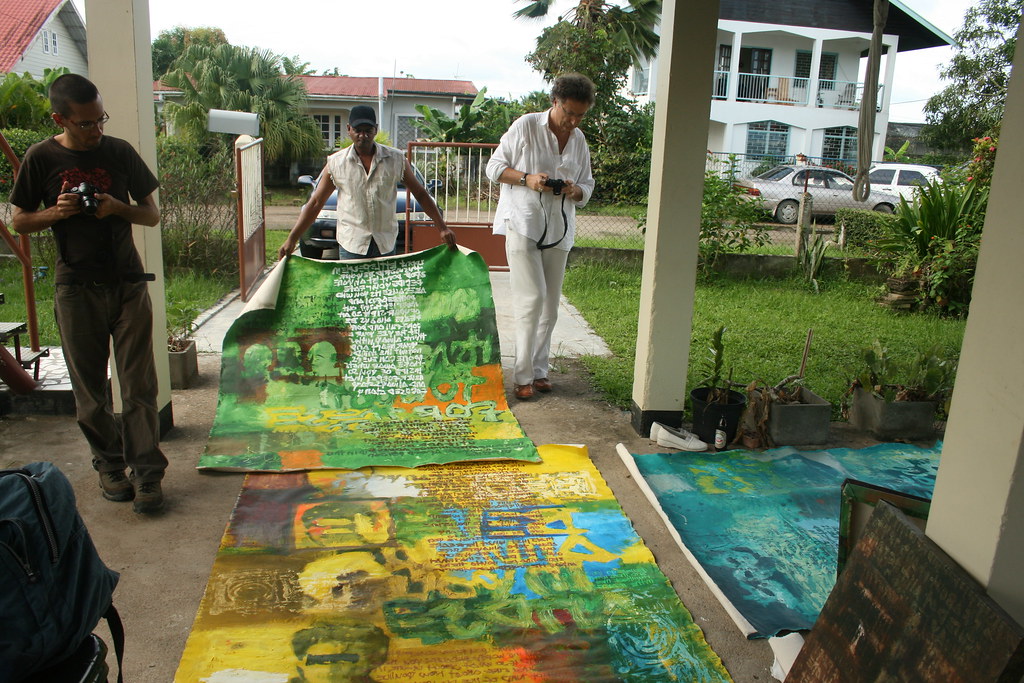
Visiting artist Ravi Rajcoomar's studio, June 2009. From left: writer Nicholas Laughlin, Rajcoomar, curator Thomas Meijer zu Schlochtern. Photo by Christopher Cozier
For me, visiting these artists is also like an out-of-body experience, as most of the time I have been on the other side, being observed. Bobbing and weaving like a featherweight boxer contending with the scrutinising gaze--contending with the conditions of visibility.
In revisiting Soeki’s studio, I was thinking of a painting I had seen in 2005. One which the artist said was inspired by the aspirations of Carifesta, and through which he confidently investigated or navigated the neo-expressionism of late Modernity, but also aligned to similar ventures in the Antilles.
At the time, I was thinking of the works of Isaiah Boodhoo, Kenwyn Crichlow, and the Parboosinghs in Jamaica, for example--artists who pursued more open gestural and less schematised surfaces. In their work, ideas about rhythm, improvisation, and how colour functions in the Caribbean are investigated, but not exclusively in perceptual pursuits. There was also a conversation/speculation around sensibility and ethnicity. It was an optimistic dialogue about cultural crossovers and integration after electoral and national politics had failed us.
Soeki Irodikromo and Christopher Cozier discussing the painting Ontmoeting, June 2009. Photo by Thomas Meijer zu Schlochtern
Instead, visiting Soeki’s studio in June 2009, I encountered another recent and casually accomplished work called Ontmoeting.
Our conversation that day drifted from his recently stolen songbird, and its spectacular trilling (or “shining”, as we say in Trinidad), to his interest in and commitment to painting. Minding these vain and fickle tropical birds is a similar extended negotiative process, with its own form and aesthetic concerns--something like painting--which has fascinated me since my childhood, and which still seems to escape my full understanding. We were finding common ground.
Looking at the worlds that artists of Soeki’s generation try to reconcile, looking back into their ongoing moment--ongoing in that their concerns remain current each time one looks at or experiences the work--asks informative questions about our current location and ways of seeing.
Read the first set of Cozier's project notes here.
Diary: visiting Soeki Irodikromo
Saturday, July 18, 2009
25 June, 2009
We begin our round of studio visits, appropriately, by calling on Soeki Irodikromo, one of the elder figures of the Surinamese art scene. His paintings, ceramics, and batik work draw on Javanese myth and visual traditions but also on the methods and style of the COBRA movement, which he studied at close quarters when he was an art student in the Netherlands in the 1960s. For forty years, Soeki--everyone in Paramaribo refers to him by his first name--has thoughtfully but undogmatically explored notions of Suriname's cultural diversity and hybridity, and the country's uncertain place within the Caribbean cultural zone.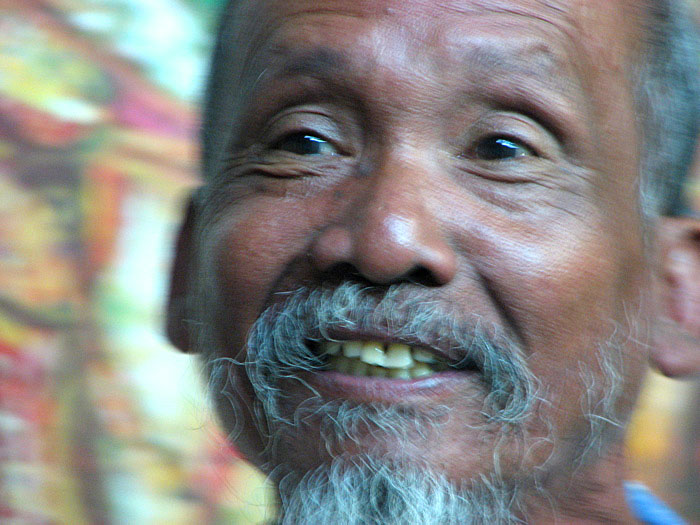
Soeki Irodikromo, 25 June, 2009. Photo by Nicholas Laughlin
Chris visited Soeki's studio last time he was in Suriname, and remembers being fascinated by a large painting created for Carifesta 2006. He hopes to see it again.
Soeki's wife greets us at the front gate and shows us past a collection of small cacti (sheltered by a big striped umbrella) into an airy verandah screened by palms and other potted plants. Just above us a nervous small songbird flits about its bamboo cage. Soeki appears in the doorway, smiling, hands clasped. He asks if we will have coffee, then ducks inside to fetch it.
"He's so fit!" Chris says. Soeki is small, wiry, energetic, dressed in a batik t-shirt. Chris remembers on his previous visit they spoke about fishing in the mouth of the Suriname River.
Soeki appears again, with little cups of coffee, and we sit around a low table made from the section of a massive tree trunk. Chris asks about the caged bird. It is a twa twa, Soeki says--"the best kind of bird in Suriname." The picolet is second best. Last week someone stole his picolet from the verandah. Now he keeps the front gate locked.
Thomas talks about our project, the exhibition and book. Soeki listens gravely. Chris asks about the Carifesta painting he saw five years ago. It was sold to a collector in the Netherlands, Soeki says, like much of his work. He opens a copy of the catalogue of his work published in 2005 and leafs through to the final section. The painting Chris remembers isn't in the book, but others from the series are.
Eventually we ask if we can see some of his most recent work, and Soeki shows us inside. Hanging on his living room wall is a new painting called Ontmoeting--"The Meeting"--finished just "yesterday", Soeki says. Chris is immediately intrigued. While he talks to Soeki about the work, I slip into his studio at the back of the house, behind the kitchen. Several canvases-in-progress stand on easels, or propped on a ledge along the wall. Soeki, Chris, and Thomas follow me into the room. Chris has shared the idea of the bridge as a thematic construct for the project. Soeki, warming to the idea, is talking about the Javanese community as a bridge between Afro- and Indo-Surinamese.
Soeki's studio, 25 June, 2009. Photo by Nicholas Laughlin
In the taxi, heading back to central Paramaribo, Chris muses over the coincidental appropriateness of finding Ontmoeting prominently displayed in Soeki's house. Because of course a bridge is a kind of meeting, and Soeki's work is a bridge between late European Modernism and a cultural discourse particular to Suriname. Can we find, Chris wonders, a bridge between ideas about the role of painting among artists of Soeki's generation, and the work of contemporary Surinamese artists working in the medium of paint on canvas?
Other resources:
= Article on Soeki Irodikromo in Dutch Wikipedia
= Article on Soeki at Readytex Gallery website
= Marieke Visser on Soeki's 2005 show at the Readytex Gallery