Showing posts with label irodikromo. Show all posts

Project: Ingiwinti, by Sri Irodikromo

Sunday, March 28, 2010

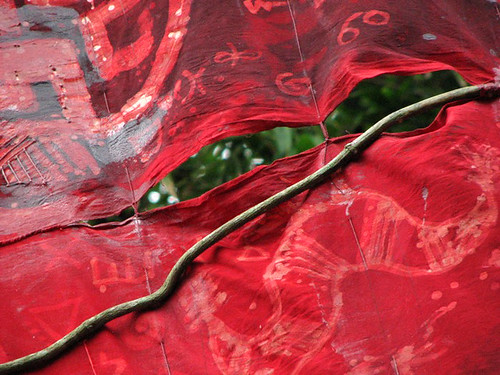
sri batik panel detail

Detail of Sri Irodikromo’s Ingiwinti


By Nicholas Laughlin

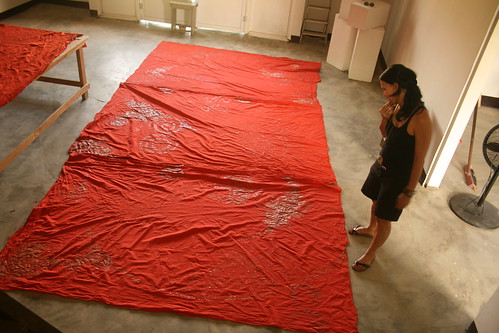
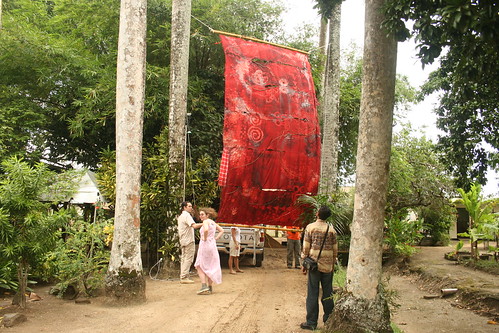
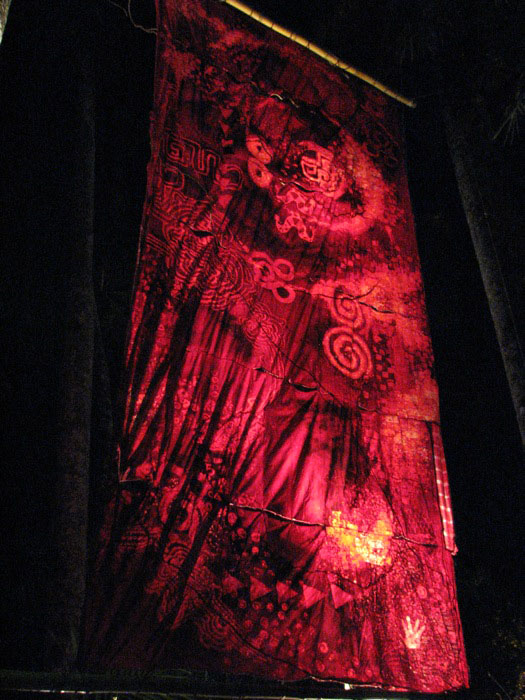
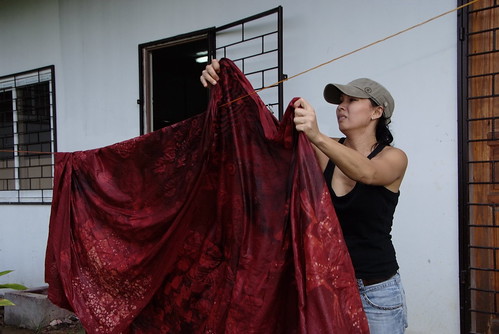
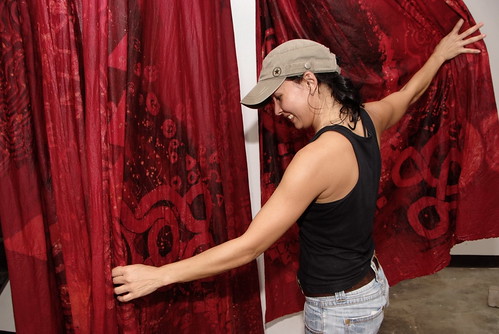
Sri Irodikromo’s Ingiwinti is a monumentally scaled batik panel, approximately thirty feet long by ten feet wide, dyed in vivid shades ranging from scarlet to crimson, and “embroidered” with dried rainforest vines and roots. For Paramaribo SPAN, it was installed outdoors, suspended from stout bamboo rods at the end of an avenue of palm trees. On the night of the exhibition opening, dramatically spotlit, this vertical apparition of gorgeous and glowing red served as a beacon, drawing visitors to the far end of the DSB Bank garden.

sri ingiwinti

Ingiwinti on the opening night of the Paramaribo SPAN exhibition


But Ingiwinti might also be seen as another kind of beacon, drawing our attention to a mental space where cultural and spiritual traditions meet and negotiate. Its title refers to a series of rituals in which winti — Suriname’s traditional syncretic religion, drawing on the beliefs and practices of several West African peoples — adopts elements from (but is also adopted by) indigenous Amerindian peoples. The colour red is traditionally worn by celebrants of ingiwinti rituals. Irodikromo says the colour also refers to the seeds of the kuswe plant — called annatto, roucou, or achiote in other parts of Latin America and the Caribbean — used as a medicine, a cosmetic, a food dye. And the symbols and motifs patterning the cloth panel are borrowed from indigenous and Maroon art and the Afaka syllabary.

Irodikromo explains that she is usually unaware of the specific meanings and nuances of these symbols. “I make my own story,” she says. “I know that the symbols have no negative messages. They are all good signs.” But this isn’t a case of straightforward cultural appropriation, and Irodikromo does not use these motifs as a shortcut to some notion of cultural authenticity. Open about her position as an outsider to Maroon and Amerindian communities, she seems to be exploring the accessibility of elements of their visual and spiritual culture to members of other communities, both within and without Suriname. She questions rather than asserts, and respects the inscrutability of beliefs and ideas outside her own experience.

_DSF5686

_DSF5677

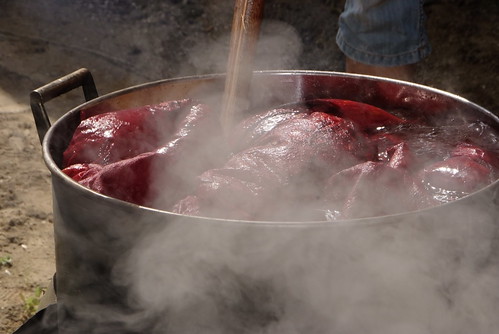
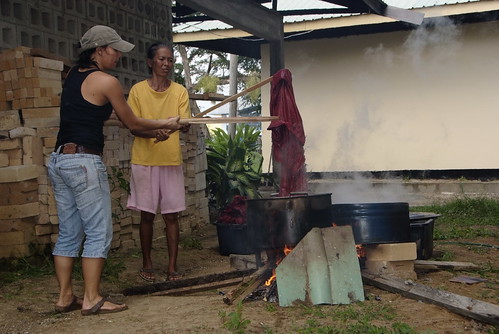
Irodikromo (left) dyeing the Ingiwinti fabric panels with the help of an assistant. Photos by Hedwig PLU De La Fuente


At the same time, the very medium of Ingiwinti creates another space of meeting and exchange. Batik is a technique of wax resist dyeing native to Indonesia and brought to Suriname by indentured Javanese immigrants, from whom Irodikromo is descended on her father’s side. In a recent conversation with artist Ellen Ligteringen, Irodikromo spoke of batik as a form of cultural preservation or recuperation:

Sri Irodikromo: I use batik on everything. I still am in the middle of experimenting.

Ellen Ligteringen: What is the essence of batik?

SI: Batik is an ancient technique. It comes from Indonesia. My roots are also from Indonesia, and that is why I work with batik.

Batik is actually saving colours. Fabric is covered with beeswax. For example, you have a white fabric, and you cover one section with beeswax, which remains white if you put the fabric in a dye bath.

EL: What other techniques play a role in your work?

SI: I not only use batik, I embroider, paint, and use grease on my canvases. I work with roots and twigs on the canvas. I use every technique I am able to work with. I see what is possible or not.

EL: You’ve worked a while in the Netherlands.

SI: I’ve done lithography and etchings.

EL: I see similarities. Etching and lithography are also about saving. You then work on a plate or a stone, but I see similarities with how you work on canvas.
_DSF5694

_DSF5717

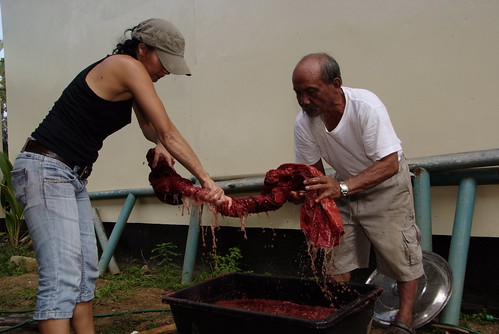
The artist working on Ingiwinti with the help of her father, Soeki Irodikromo. Photos by Hedwig PLU De La Fuente


For an older generation of Surinamese (and Caribbean) artists — such as Soeki Irodikromo, Sri’s father — the combination of symbols and forms drawn from their country’s various ethnic communities was often a way of describing and asserting a national identity, of hypothesising if not celebrating an idea of national unity. In a work like Ingiwinti, Irodikromo seems more tentative, negotiating between the familiar and the strange in search of a position of understanding and accommodation. At the same time, its scale and powerful visual presence suggest that to be tentative is not necessarily to be vague or indecisive. Questions can be as powerful as declarations.

_DSF5743

Photo by Hedwig PLU De La Fuente

SRI PROJECT  2

Photo by Christopher Cozier

SRI INSTALL 3

Installing Ingiwinti in the DSB Bank garden. Photo by Christopher Cozier

Elsewhere: March 2010 issue of Sranan Art Xposed

Wednesday, March 17, 2010

.


The March 2010 issue of the e-magazine Sranan Art Xposed — edited by Marieke Visser, Cassandra Gummels-Relyveld, and Priscilla Tosari, with the support of the Readytex Art Gallery — covers the Paramaribo SPAN exhibition, and also features an interview with artist Sri Irodikromo and notes on other recent exhibitions and artists’ projects. It is available in both English and Dutch editions, and can be downloaded from the Readytex website.

Diary: three days to the opening

Tuesday, February 23, 2010

ravi rajcoomar floor writing

Detail of Ravi Rajcoomar's SPAN installation


With three days remaining until the opening of the Paramaribo SPAN exhibition, all the members of the SPAN curatorial and organising team are now in Paramaribo, and installation of the artists' works is almost complete at the main exhibition venue, the DSB garden.


roddney installing

Roddney Tjon Poen Gie working on his installation at the DSB garden. His project is a collaboration with photographer Sirano Zalman


The former director's villa and extensive grounds behind De Surinaamsche Bank's headquarters provide numerous indoor and outdoor spaces for works by twenty-nine Surinamese and Dutch artists, some of them created specifically for these sites. On opening night, Friday 26 February, the DSB garden will be illuminated by thousands of lights as guests encounter works including painting, photography, sculpture, installation, video, and several performance projects.


sri installing

Sri Irodikromo installing her work in the DSB garden

sunil puljhun

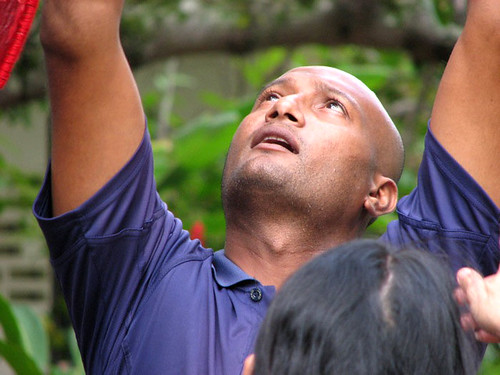
Sunil Puljhun helps install Irodikromo's work

Document: Afaka's first letter

Wednesday, September 9, 2009


ke mi gadu | mi masa | mi bigi na ini a ulotu | fu a papila di yu be gi afaka...


It's estimated there are 25,000 to 30,000 speakers of Djuka (or Ndyuka), one of the Maroon languages of Suriname and French Guiana. Derived from English and several West African languages, Djuka has three distinct spoken dialects as well as a written form, called Afaka script after its creator.

Afaka Atumisi was a Djuka from the Tapanahony region of south-eastern Suriname. Circa 1910 -- inspired, he said, by a dream or vision -- he invented a syllabary of 56 characters which allowed Djuka texts to be recorded and transmitted in writing. Afaka died in 1918, but by 1920 it was reported that over a hundred people in the Tapanahony area could read and write his script.


kibi wi 2

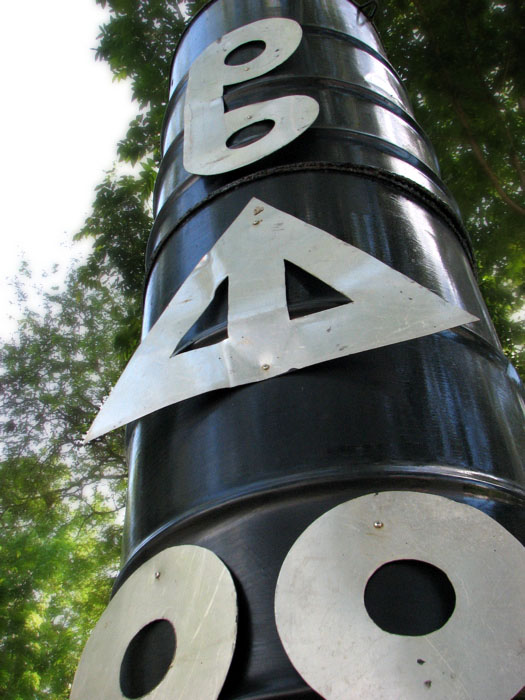
Detail of one of Marcel Pinas's Kibi Wi totems, made from oil drums decorated with aluminium Afaka characters; Fort Zeelandia, Paramaribo, April 2009. Photo by Nicholas Laughlin


In later decades, the number of fluent readers and writers declined -- an article in the Suriname Museum journal in 1975 estimated that "most probably there remain only five." But more recently Afaka script, like other elements of Maroon culture, has been increasingly adopted (and adapted) as a symbol of Surinamese national identity, and the script is not an unfamiliar sight in Paramaribo. Afaka characters are a recurring and assertive motif in the work of Marcel Pinas, a member of the Djuka community in Moengo, but Surinamese artists from other ethnic backgrounds -- including Roddney Tjon Poen Gie and Sri Irodikromo -- also use the script in their exploration of the country's ethnic intricacies.


Air Borne (acrylic on canvas, 67 x 100 cm, 2009), by Roddney Tjon Poen Gie; photo by William Tsang, courtesy Readytex Art Gallery.


"Tjon Poen Gie is well known for using his own visual language, which is based upon the letter symbols of his ancestors," says the Readytex Gallery website." He draws the characters and symbols three-dimensionally and thus produces a playful abstraction of Chinese letters and Afro Surinamese Afaka symbols in his artwork."

The document reproduced at the top of this post is one of the earliest surviving texts written in Afaka script -- a letter by Afaka Atumisi which reports on his unsuccessful trip to the hospital in Paramaribo in search of treatment. Read a full translation here.

Meanwhile: July and August 2009

Wednesday, July 22, 2009

=
Notes on other current and upcoming art events in Suriname and elsewhere


Kon u Taki (mixed media on canvas, 148 x 197 cm, 2009), by Marcel Pinas. Photo by William Tsang, courtesy Readytex Art Gallery


= Double Feature: Marcel Pinas and Sri Irodikromo
Readytex Art Gallery, Paramaribo; July 15 to July 25, 2009

Separate collections by two very different artists, each with a distinctive and unique style, although they each choose a strikingly bright colour palette, regularly use pangi textiles, and work from strong culturally inspired themes.

= The Time: solo exhibition by Robbert Enfield
Royal House of Art, Paramaribo; July 25 to August 8, 2009

“Everybody is affected by the time we are living in. But most of them act as if it doesn’t affect them at all. I want to open people’s eyes, tell the spectators: ‘Don’t hide, don’t pretend.’” --Robbert Enfield, July 2009

= Eat the Frame: with work from René Tosari, Carl Pope, Gean Moreno, Jean Bernard Koeman, Anton Vrede, Hamid el Kanbouhi, Dwight Marica, Eric Reding, Miek Hoekzema, Mirjam Kort, Kaleb de Groot and Moshekwa Langa; curator Michael Tedja
Galerie Nouvelles Images, The Hague, the Netherlands; 27 June to August 22, 2009

As the exhibition Eat the Frame was developing, curator Michael Tedja wrote a fictitious story, Hosselen ("to hustle"). The main character is a young curator busy preparing an international exhibition. His path through life is marked by various twists and turns. The novel is written in facets. Like a diamond, a brilliant which has 58 facets, the book is composed of 58 chapters, each telling a story about art and the art world in the Netherlands. By the end of the book, the young curator steps out of the framework of the story and so exits the fiction. The exhibition is being hosted by Nouvelles Images and the catalogue of the exhibition is the final chapter of Hosselen. Eat the Frame is now a reality

= Licht aan Zee AA: with work from Remy Jungerman, Iris Kensmil, Marcel Pinas, Kurt Nahar, David Bade, Tirzo Martha, Papa Adama, Luan Nel, Vitshois Mwilambwe and Meshac Gaba; curator Georges Hanna, guestcurator Remy Jungerman
De Kunstuitleen, Den Helder, The Netherlands; 1 May to August 29, 2009

The theme of Licht aan Zee AA is culture and cultural differences, with a focus on Africa and the Antilles. Guest curator Remy Jungerman, together with Iris Kensmil and Kurt Nahar, has presented a collection under the title "Born on Wednesday", following the Afro-Surinamese tradition of naming babies after the day they are born.

= Togetherness: solo exhibition by Raimen Bijlhout
Cultureel Centrum Suriname (CCS), Paramaribo; August 7 to 13, 2009

Togetherness is about the "unity of the culture of the Afro-Surinamese urban population and the maroon people in the interior". Bijlhout completed his art education at the Nola Hatterman Art Academy in 2006. In 2008 he had his second solo exhibition, New Beginnings, in the Instituto Venezolano para la Cultura y la Cooperacíon (IVCC).

-- Compiled by Marieke Visser and Priscilla Tosari